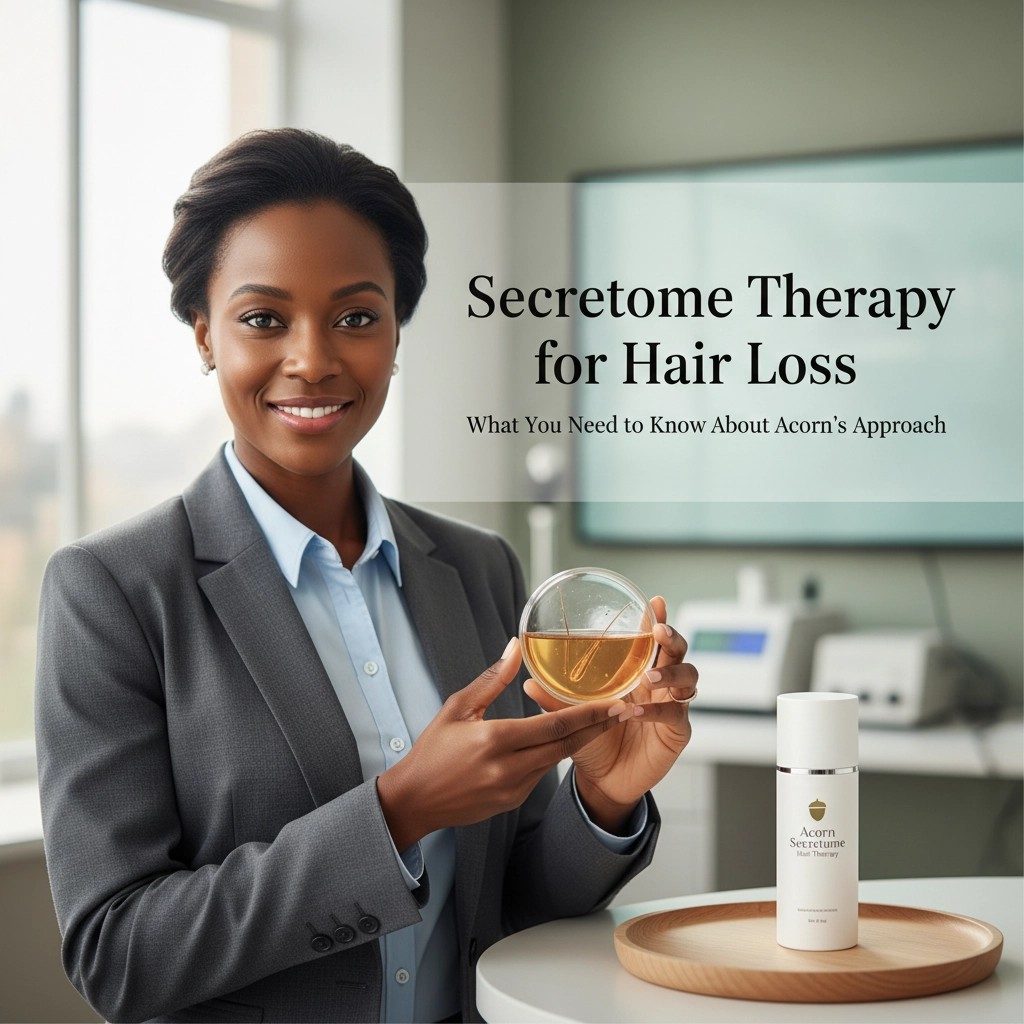
Secretome Therapy for Hair Loss: What You Need to Know About Acorn's Approach
The hair restoration landscape is constantly evolving, with new technologies promising better outcomes for patients struggling with hair loss. One of the latest developments generating attention is secretome therapy, particularly Acorn's personalized approach. As with any emerging treatment, it's important to understand what this therapy involves, how it compares to established methods, and what realistic expectations patients should have.
Understanding Secretome Therapy
Secretome therapy represents a significant shift in regenerative medicine for hair restoration. Unlike traditional treatments that focus on transplanting hair or blocking DHT hormones, secretome therapy works at the cellular level to potentially reactivate dormant hair follicles and improve scalp health.
A secretome is essentially the collection of proteins, growth factors, cytokines, and other bioactive molecules that stem cells naturally release as part of their communication and healing processes. These molecules play crucial roles in tissue repair, inflammation reduction, and cellular regeneration. In the context of hair restoration, the theory is that these factors can stimulate hair follicles that have become inactive due to androgenic alopecia or other forms of hair loss.
What makes Acorn's approach unique in the market is their emphasis on personalization.
Rather than using generic secretome products, they create individualized treatments using a patient's own stem cells, harvested from their hair follicles. This autologous approach theoretically reduces the risk of immune reactions while providing a treatment specifically tailored to an individual's biological profile.
The Acorn Process: From Collection Treatment
Acorn's treatment protocol begins with a relatively simple collection procedure. During an in-office visit, a trained technician carefully plucks approximately 50 hair follicles from the back of the patient's scalp. This might sound concerning, but with an average of 100,000 to 150,000 hairs on a healthy scalp, the removal is barely noticeable and doesn't impact overall hair density.
These collected follicles are then sent to Acorn's laboratory, where the stem cells are isolated and cultivated under controlled conditions. The stem cells are encouraged to release their secretome into a nutrient-rich culture medium. This fluid is then collected, processed through lyophilization (freeze-drying), and prepared for therapeutic use.
When patients return for treatment, the freeze-dried secretome is rehydrated with low molecular weight hyaluronic acid and applied to the scalp. Some patients may also receive take-home applications for continued use over a two-week period following the initial treatment.

How Secretome Therapy Compares to Established Treatments
To understand where secretome therapy fits in the hair restoration landscape, it's helpful to compare it with proven treatments like FUE hair transplants and PRP therapy.
Versus Hair Transplants (FUE): Hair transplant procedures like Follicular Unit Extraction (FUE) remain the gold standard for significant hair loss, particularly in cases where patients have extensive balding. FUE involves physically moving healthy hair follicles from donor areas to recipient sites, providing permanent, predictable results. However, it's a surgical procedure with associated downtime and costs.
Secretome therapy, by contrast, is non-surgical and aims to work with existing follicles rather than transplanting new ones. This makes it potentially suitable for earlier stages of hair loss or as a complementary treatment to help optimize transplant results and donor area healing.
Versus PRP Therapy: Platelet-Rich Plasma (PRP) has been used in hair restoration for over a decade, with a substantial body of research supporting its efficacy for certain types of hair loss. PRP uses a patient's own blood platelets, which are concentrated and injected into the scalp to deliver growth factors.
Acorn claims their secretome contains growth factors at levels up to 34 times higher than PRP, which sounds impressive. However, it's important to note that higher concentrations don't necessarily translate to better results, and the clinical evidence supporting secretome therapy is still developing compared to PRP's established track record.
Potential Benefits and Realistic Expectations
Proponents of secretome therapy highlight several potential advantages. The autologous nature of the treatment minimizes the risk of allergic reactions or rejection, since the secretome is derived from the patient's own cells. The non-surgical approach means no downtime, making it attractive for patients who want to avoid the recovery period associated with hair transplants.
The therapy is positioned as addressing multiple aspects of hair and scalp health simultaneously – potentially reducing inflammation, supporting follicle function, and improving overall scalp condition. For patients in the early stages of hair loss, this comprehensive approach may help slow progression and improve hair quality.
However, realistic expectations are crucial. Most patients who see improvements typically notice changes around the 3-4 month mark, and results can vary significantly between individuals. Unlike hair transplants, which provide predictable coverage in treated areas, secretome therapy's effects depend on the responsiveness of existing follicles and the progression of underlying hair loss causes.

The Stem Cell Banking Component
An interesting aspect of Acorn's offering is their stem cell banking service. Along with creating the secretome treatment, they preserve some of the collected stem cells through cryogenic freezing at -196°C. The concept is that these cells remain viable for potential future use as regenerative medicine advances.
While this sounds forward-thinking, patients should understand that stem cell banking for cosmetic purposes is still largely speculative. The field of regenerative medicine is indeed advancing rapidly, but there are no guarantees about what treatments will be available in the future or how preserved stem cells might be utilized.
Who Might Benefit Most
Secretome therapy appears most suitable for patients in specific situations. Those experiencing early signs of hair thinning who want to explore regenerative options beyond conventional treatments may find it appealing. It's also potentially valuable as a complementary therapy alongside other procedures, possibly helping to optimize healing and results.
Patients planning other aesthetic procedures on the scalp, such as laser treatments or microneedling, might benefit from secretome therapy's potential healing and regenerative effects. Additionally, those interested in the concept of preserving their cellular potential for future use might find the banking component attractive.
However, patients with advanced hair loss would likely see more dramatic results from established treatments like hair transplants, possibly using secretome therapy as an adjunct to optimize outcomes.

Evaluating New Therapies: A Balanced Perspective
As with any emerging treatment in aesthetic medicine, it's important to approach secretome therapy with both optimism and healthy skepticism. The theoretical foundation is sound – stem cell-derived factors do play important roles in tissue repair and regeneration. However, the transition from laboratory promise to consistent clinical results isn't always straightforward.
The personalized aspect of Acorn's approach is compelling, but it also means that results may be more variable than with standardized treatments. While some patients may see excellent improvements, others might experience minimal changes, making it difficult to predict outcomes for any individual patient.
Making an Informed Decision
For patients considering secretome therapy, the decision should be made in consultation with experienced hair restoration professionals who can provide objective guidance based on individual circumstances. Factors to consider include the stage and pattern of hair loss, previous treatments tried, budget considerations, and personal preferences regarding surgical versus non-surgical approaches.
It's also worth noting that secretome therapy isn't necessarily an either/or decision with established treatments. Many patients may benefit from a comprehensive approach that combines proven methods with newer adjunct therapies.
The field of hair restoration continues to evolve, and secretome therapy represents an interesting addition to available options. While the technology shows promise, patients should maintain realistic expectations and work with qualified professionals to determine the best approach for their specific needs and goals.
As more clinical data becomes available and treatment protocols are refined, secretome therapy may establish itself as a valuable tool in the hair restoration toolkit. For now, it represents an intriguing option for patients seeking cutting-edge approaches to hair loss, particularly those interested in regenerative medicine's potential.